
Revisiting La La Land Ten Years Later: Here's to the Fools Who Dream
Revisiting La La Land Ten Years Later: Here's to the Fools Who Dream
Written on the tenth anniversary of La La Land's release—ten years later, from jazz decay to love choices, reflections on dreams and reality.
Contents
- Decade · Stars and Rust
- Jazz · Decay and Persistence
- Love · Dreams and Choices
- Fools · Tribute and Release
Decade · Stars and Rust
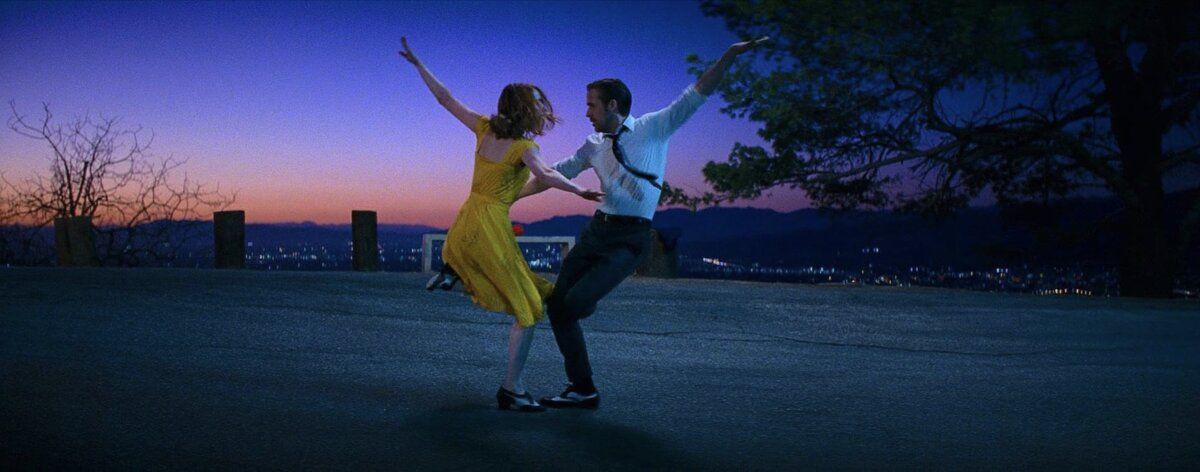
When La La Land was released in 2016, I don't quite remember if I watched it in the cinema or if it wasn't released in mainland China—I watched it on my computer at some point, then caught it during the re-release at the cinema. At the time, I knew nothing about jazz, but I remember Sebastian's line:
"It's conflict and it's compromise, and it's just... it's new every time. It's brand new every night."
Ten years later, it's Valentine's Day again. Now it's February 14, 2026—the second time I've watched La La Land in a theater. The theater was nearly empty (fewer than 10 people). When the lights came on at the end, I felt an inexplicable emptiness—not disappointment, but that dazed feeling after reliving a beautiful dream.
The Los Angeles on screen remains that dreamy "City of Stars," Griffith Park's sunset still paints the skyline red, the Hollywood sign still glitters at night. But I found I couldn't fully immerse myself in the film's romance anymore—not because the movie changed, but because my view of the world changed.
2016 was Obama's final year in office. The U.S. economy was slowly recovering from the financial crisis, Silicon Valley's tech boom was in full swing, and Hollywood was still the dream factory. "The American Dream" didn't yet sound like an irony. Los Angeles was the promised land for countless dreamers. Sebastian's line in the film—"Do you remember Louis Armstrong? He could have just played the marching band charts he was given, but what did he do instead? He made history"—felt like a love letter to all dreamers.
What about 2026? Deportation flights have hit record highs, ICE raids have become routine news, and the U.S.—once seen as the "land of opportunity"—now frequently appears in discussions about "Kill Lines" and "going home." Of course, movies are movies, reality is reality—the LA sunset doesn't change color with political winds, Griffith Observatory still stands atop the hill. But it's hard to pretend the "City of Stars" dream remains intact.
Interestingly, the 2016 film itself planted something prophetic. Sebastian is a struggling jazz pianist who can't hold down a stable job, can't even afford car insurance—but he insists on opening a place called "Chicken on a Stick." Yes, that ridiculous name is serious, just to preserve pure jazz. The film doesn't hide his poverty and mess—Sebastian has an almost stubborn idealism that might be worthless in reality, but I think it's precious enough to break your heart.
Looking back ten years later, this idealist's dilemma seems more common than ever. It's not just jazz that's "dying"—many things we once took for granted are becoming "heritage." In the film, Sebastian's friend Keith has already moved toward a less pure form of jazz, with more electronic and pop-influenced sounds. This line Keith says behind Sebastian's back stuck with me:
"How are you gonna be a revolutionary if you're such a traditionalist? You hold onto the past, but jazz is about the future."
In 2016, this sounded like a friendly reminder. Ten years later, it feels like an omen of the times. The tension between "holding on" and "adapting" isn't just an artistic choice—it's become a matter of survival.
Jazz · Decay and Persistence
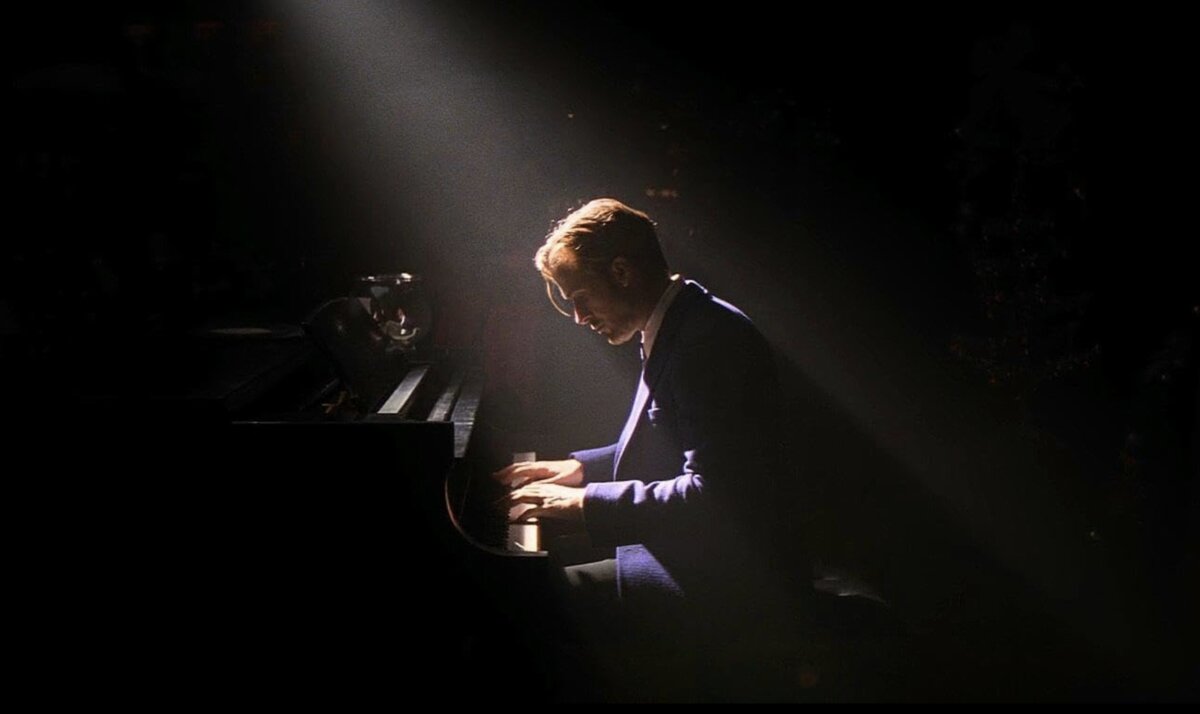
It's not an overstatement to say La La Land is a film about jazz. Director Damien Chazelle practically wrote a love letter to jazz with this movie.
The most touching thing about Sebastian isn't his talent—it's his religious devotion to jazz. There's a scene where Seb plays a restaurant's agreed-upon Christmas song at a fancy restaurant. The manager, for some reason, hates "Free Jazz." Seb starts improvising a jazz piece that has nothing to do with Christmas atmosphere—Mia & Sebastian's Theme—the same song that brings Seb and Mia together for the second time. But the restaurant manager fires Seb during the Christmas season. Seb walks out without looking back, ignoring Mia's greeting.
This scene takes only a few shots but completely establishes Sebastian as a character. He's not unwilling to compromise—he's unwilling to compromise on his principles. In his world, jazz isn't just a music genre—it's a way of living. Every night of performance is brand new, every improvisation is an adventure. "It's very, very exciting!" he says this with light in his eyes. Yet jazz faces its own challenges:
"They worship everything and they value nothing."
But the film doesn't reduce Sebastian to an "idealist martyr." Chazelle makes him face real dilemmas: no money, no audience, no way forward. His sister Laura is right—he wasn't "conned" into anything, he conned himself. He can't open that jazz club, he can't even afford rent.
The confrontation between Sebastian and Keith reveals the core of the problem:
Keith: "How are you gonna be a revolutionary if you're such a traditionalist? You hold onto the past, but jazz is about the future."
Sebastian insists on "purity"—but does that purity have vitality in the present? Keith represents "fusion," a way to keep jazz alive, but is that way of surviving still jazz?
Sebastian eventually joins Keith's band. He needs that stable income. The film doesn't beautify this choice—Seb playing those "safe" pop hits on stage has an indescribable emptiness in his eyes. He got stability, but lost his soul.
But the ending is warm. Five years later, Seb finally opens his own jazz club "Seb's"—the name Mia gave it. The bar is full of people, they come to hear real jazz. When Mia walks through the door, Sebastian plays their song, Mia & Sebastian's Theme, on stage.
Has jazz "died"? No. At least not in the film. Sebastian spent five years, in a smarter way, living exactly how he wanted. This is probably the best footnote to "Here's to the fools who dream"—not blindly hitting walls, but finding a way after hitting them.
Extended: The Fate of Musicals
Interestingly, the dilemma facing jazz is also what the musical genre is dealing with. I personally love musicals—from Moulin Rouge! to Chicago to The Greatest Showman, these are all movies I really enjoy. Musicals were once Hollywood's signature genre. But nowadays, musicals have become a "niche" genre—there are barely a handful of live-action musical films released each year. La La Land's arrival once gave many people hope for a musical revival, but ten years later, the market environment for genre films hasn't changed much.
Perhaps it's exactly this "outdated" quality that gives La La Land its unique retro beauty. It's like a love letter to "the good old days"—charming and bittersweet.
Love · Dreams and Choices
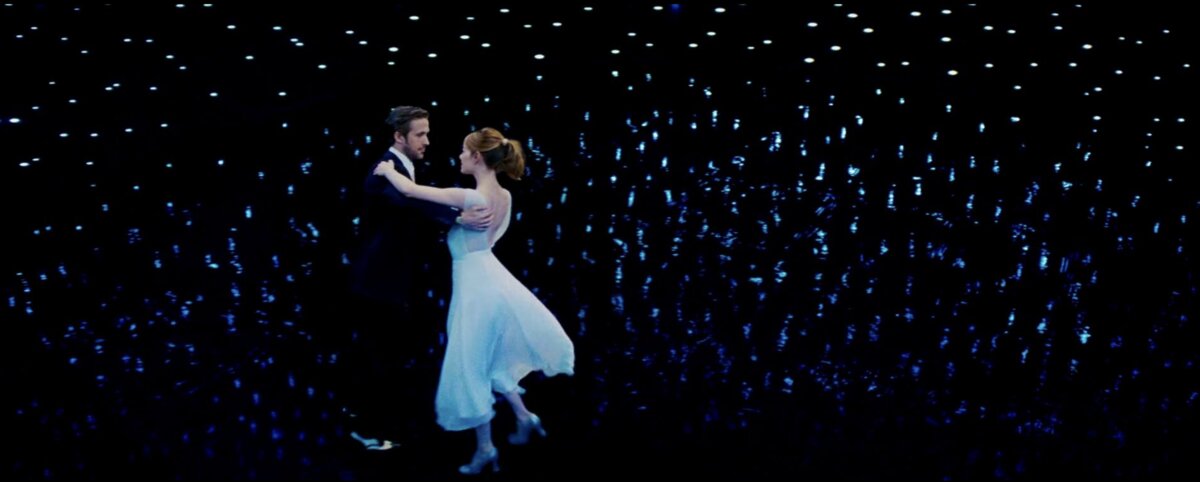
Seb and Mia's love is the skeleton of the entire film.
Their meeting wasn't romantic—Sebastian and Mia "argued" because of honking on the highway, and Mia's first impression of him was terrible. The second time should have been at the restaurant, Mia greeted Seb but was ignored, extremely awkward. The third time at a party, Mia ordered "I Ran" which broke the "serious musician" Seb, but it also allowed Seb and Mia to talk for the first time.
But that's how love works—it doesn't care about your prepared script.
What followed was a romantic love story: dancing under the stars at the observatory, sunset at Griffith Park, impromptu performances at the café. Seb took Mia to hear real jazz, Mia went from "I hate jazz" to "I started liking jazz because of you." This is probably the best part of love—because of one person, you open a door you never thought you'd walk through.
But the most honest thing about this film is that it doesn't give love a perfect fairy tale ending.
When Mia was preparing her one-woman show, Seb was touring with his band. They argued at home, and Seb said the most hurtful thing:
"Maybe you liked me more when I was a failure because it made you feel better about yourself."
Seb missed Mia's one-woman show because of the band photo, and lost Mia. Of course, later Seb went to find Mia and convinced her to go for a movie audition in Paris. Five years later, she became a famous actress, married someone else, had her own child. Her reunion with Sebastian is at his jazz club "Seb's."
That scene is the most dreamy part of the entire film. Sebastian plays that song, and the screen starts flashing back. If they hadn't separated, if they'd been together—what would it have been like? They would have gotten married, had kids, taken the kids to the park on some Sunday afternoon, kissed at sunset, been together forever.
Then the song ends and the dream wakes up. Mia has her husband beside her, Seb is on stage. They look at each other and smile, saying nothing.
Mia: "I'm always gonna love you."
Sebastian: "I'm always gonna love you, too."
Some people may love each other but can't be together.
I've always wondered why Chazelle wrote the ending like this. Is it because he's not romantic enough? Quite the opposite. I think he understands better than anyone that real romance isn't "they lived happily ever after"—it's "I'll always remember the moments we had together." Life is made up of countless moments, as long as those moments were real at the time, that's enough—they don't have to last forever.
Neither Seb nor Mia gave up their dreams for love. This is the most cruel and honest part of the film. Mia didn't stay in LA for Seb, Seb didn't give up his jazz dream for Mia. They each moved forward, chasing their own stars, then accidentally reunited one day in the future, peacefully letting go, each at peace.
This is probably adult love—not a choice between one thing or another, but each carrying their own responsibilities and making their own trade-offs.
Fools · Tribute and Release
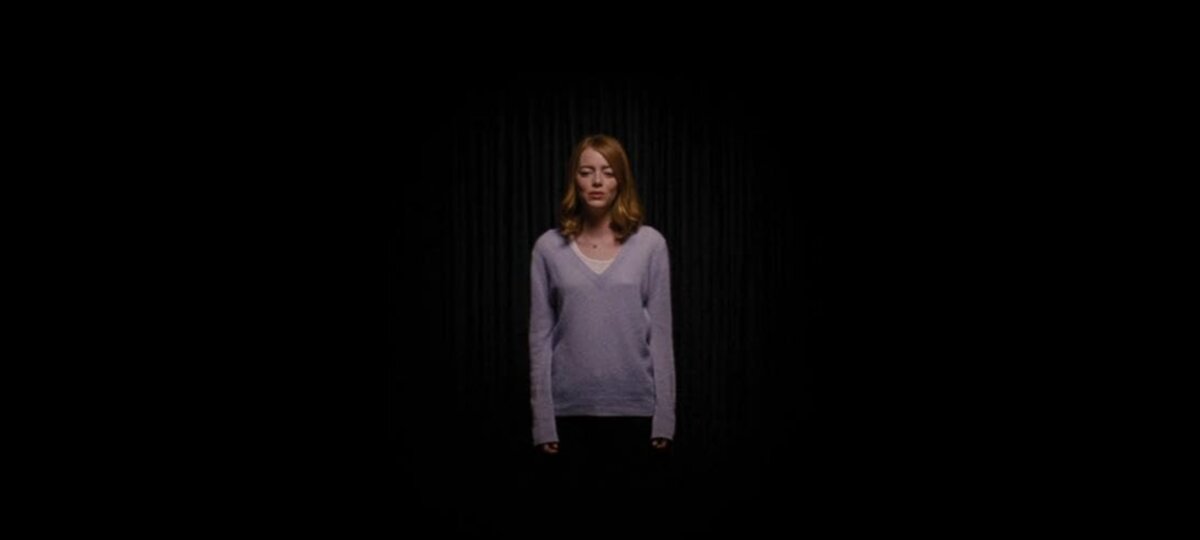
If La La Land has only one theme, it must be this song:
Here's to the fools who dream
Crazy as they may seem
Here's to the hearts that break
Here's to the mess we make
"Audition (The Fools Who Dream)" is the eye of the entire film.
At the climax of the film, Mia stands in the audition room and sings this song. She tells the story of her aunt:
"My aunt used to live in Paris. I remember, she used to come home and tell us stories about being abroad. And I remember she told us that she jumped into the river once..."
Mia's aunt probably didn't achieve any "accomplishments" in the worldly sense. But she jumped into the Seine in winter—she had one moment of reckless madness. When Mia tells these stories, there's light in her eyes. I was deeply moved when I first heard it, and a bit confused—why jump into the Seine? Later I thought about it—jumping into the Seine is probably what "The Fools Who Dream" would do.
This song is sung for aunt Mia, but also for all the "fools." Those who chase their dreams no matter what, those who aren't understood, those who still smile and say "one more time" after crashing and burning.
Seb is a fool. He could have earned stable money, but he insisted on opening a jazz bar that might have no customers.
Mia is a fool. She gave up her law school degree, dropped out, worked as a café front desk in Hollywood, got rejected in audition after audition.
But it's these "fools" that make up the most precious things in this world.
Watching this film again after ten years, I finally understood the meaning of that "fantasy scene" at the end. It's not about being unwilling to accept—it's about release. Seb and Mia each achieved their own dreams, they didn't end up together, but that doesn't mean their love failed. They were the most important people in each other's dream-chasing journeys, the reason the other could keep going. This kind of feeling is deeper than "being together."
In Closing
Watching La La Land on Valentine's Day is a bit strange. This film isn't about happy-ending love—it's about another form of love.
In ten years, the dreaming and struggling in the film are no longer stories on screen—they're things I experience every day. I'm not as stubborn as Sebastian, not as brave as Mia, but I understand that impulse to "want to do something."
La La Land doesn't tell me "dreams will definitely come true"—it's not that naive. What it tells me is: those foolish dreamers, those who jumped into the Seine, those who crashed headfirst into their ideals—their madness wasn't wasted.
Maybe one day, like Sebastian, we'll all open our own "Seb's." Maybe when that day comes, the person sitting next to us won't be the one who watched the sunset with us at Griffith Park anymore. But that's not important. What matters is that we once dreamed that dream together.
Here's to the fools who dream.
Also, I hope we can all find our passion:
Mia: "People love what other people are passionate about."
🎉 Here's to all the fools who are still dreaming.
✍️ Powered by Neardws
Last updated: February 14, 2026
Please use Safari for the best experience. © 2024-2034 Neardws.com All Rights Reserved.